
Overview & Thesis
Procter & Gamble (PG) is currently trading near multi-month and multi-year lows after a prolonged period of valuation compression. Despite this price weakness, PG’s business fundamentals remain strong, with billions in free cash flow, high margins, strong returns on capital, and a well-covered dividend.
This disconnect between price action and business quality creates a compelling setup for a high-delta LEAPS call strategy, where we aim to profit from a mean-reversion rebound rather than a speculative breakout. The strategy focuses on capturing delta expansion and price recovery, not holding options until expiration.
Technical Charts Analysis
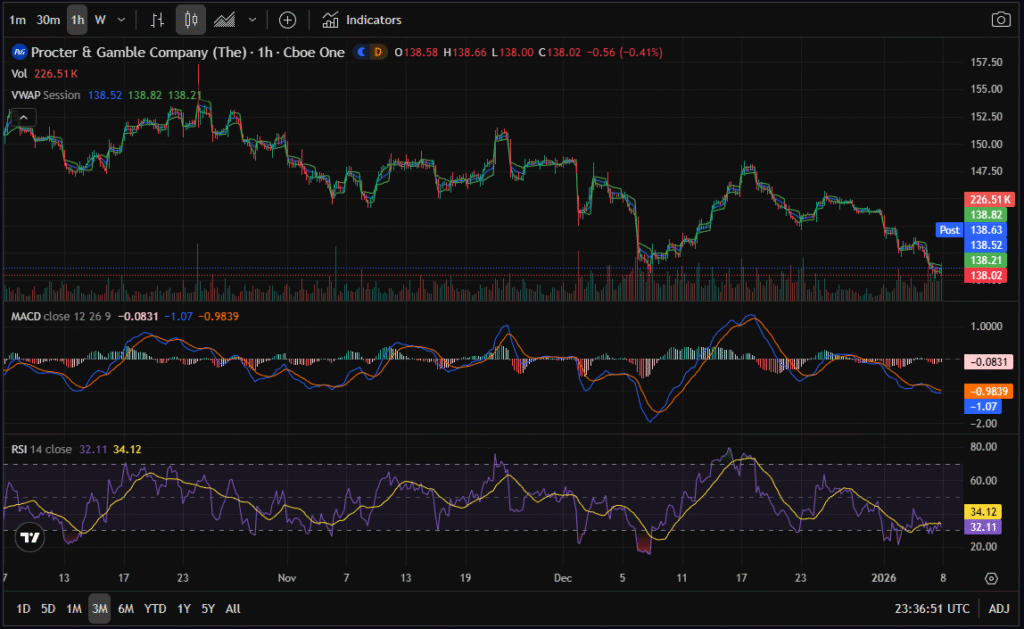
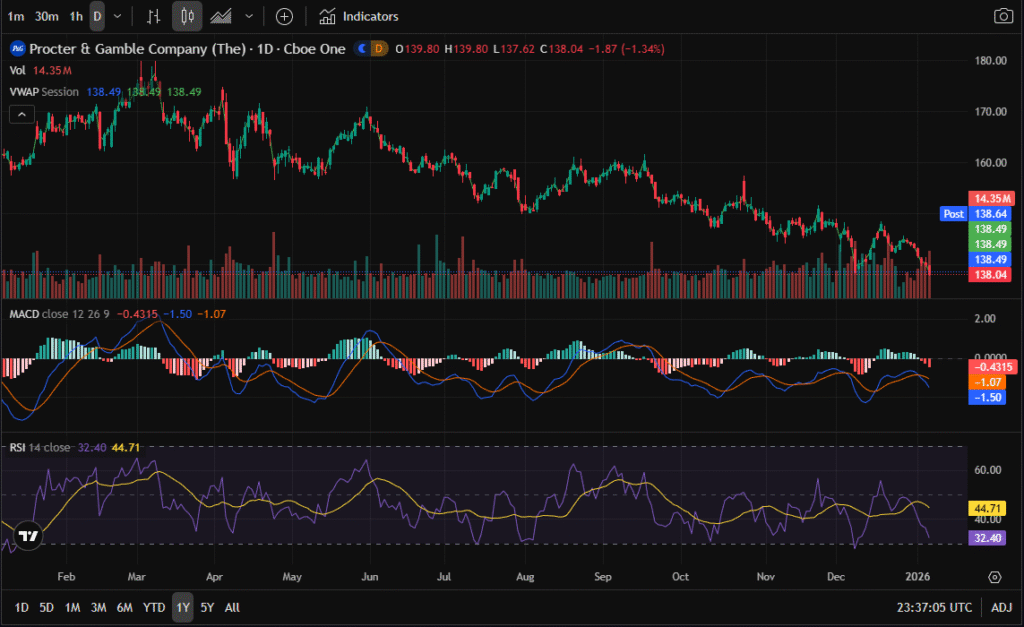

From a multi-timeframe perspective:
- 3-Month Chart: PG is trading at a 3-month low with RSI near oversold territory. Momentum remains weak, but downside acceleration has slowed.
- 1-Year Chart: PG is at or near a 1-year low. MACD remains bearish, confirming the downtrend, but RSI is no longer extreme—suggesting selling pressure may be exhausting.
- 5-Year Chart: PG is testing a major structural support zone that has historically acted as long-term demand. Weekly RSI is near oversold levels, which is rare for a defensive consumer staples stock.
Technical conclusion:
This is not a confirmed reversal yet, but it is a high-attention zone where rebounds often originate, especially when fundamentals remain intact.
Financials & Fundamentals

PG’s financial profile remains exceptionally strong:
- Free Cash Flow (TTM): ~$15B
- Gross Margin: ~51%
- Operating Margin: ~24%
- Net Margin: ~20%
- ROE: ~32%
- ROIC: ~21%
- Debt-to-Equity: ~0.67
- Dividend Yield: ~3%
These metrics confirm that PG’s price decline is not driven by business deterioration, but by valuation compression and capital rotation. This is exactly the type of setup where long-dated, high-delta options can outperform.
News Headlines & Market Narrative

Recent headlines show:
- Minor institutional trimming, not mass exits
- PG underperforming while the broader market rallies
- Continued inclusion in dividend-focused investment commentary
There are no negative earnings warnings, margin collapse concerns, or balance-sheet stress signals in the news flow. The narrative is one of defensive sector fatigue, not company-specific risk.
Analyst Price Targets
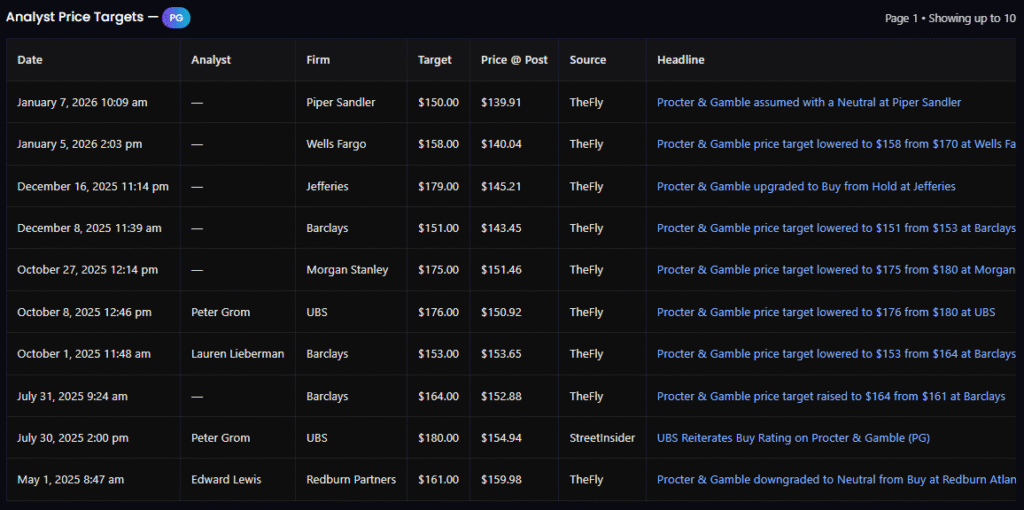
Sell-side analysts have recently trimmed price targets, but importantly:
- Targets still cluster well above current price
- No coordinated downgrade wave
- Several firms maintain Buy or Neutral ratings
This indicates analysts are adjusting valuation assumptions, not abandoning the long-term thesis.
Insider, Senate & House Trading Activity


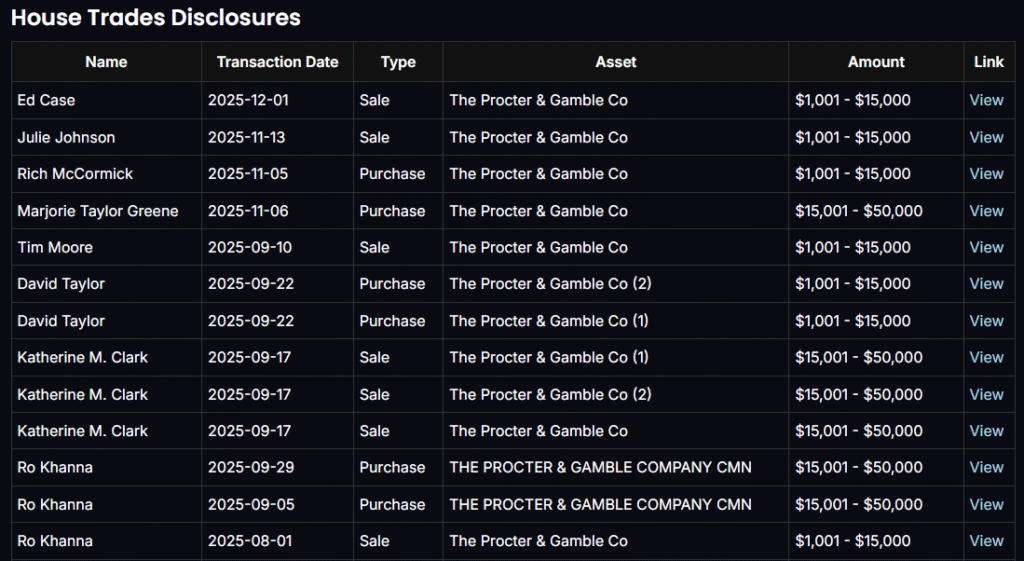
Key takeaway:
- No meaningful insider selling
- Executive transactions are mostly compensation-related
- Political trades are small, mixed, and non-informative
The absence of insider selling at multi-year support is quietly supportive of the long-term thesis.
Options Flow Analysis (Short-Term Context)


Short-dated options show:
- Heavy call open interest above spot
- Overhead resistance from call overwriting
- No evidence of aggressive short-term bullish speculation
This reinforces the idea that upside will likely be slow and grindy, not explosive—which further supports using long-dated LEAPS instead of short-term calls.
LEAPS Option Setup (Core Strategy)
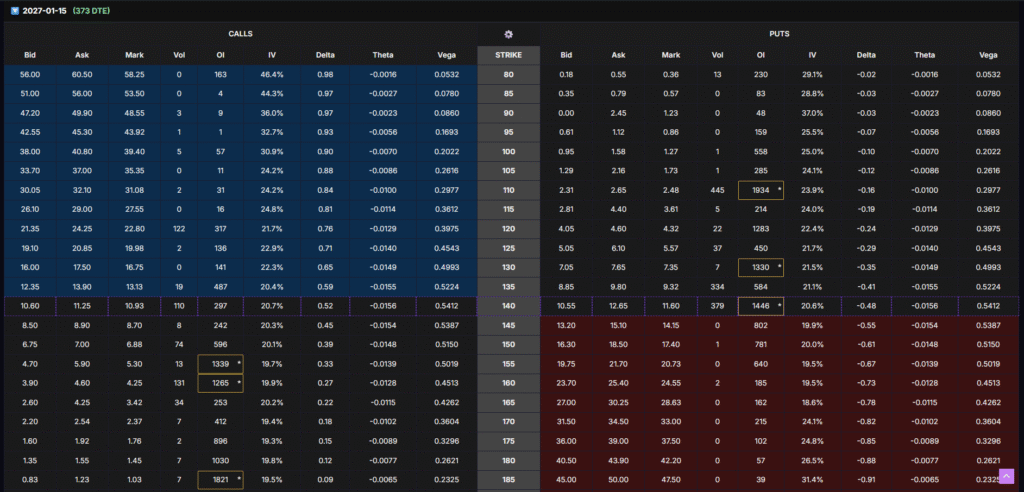
We are targeting a deep-in-the-money LEAPS call with:
- Expiration: January 2027 (≈ 370–500 DTE range)
- Strike: $120 Call
- Delta: ~0.70–0.76
- Rationale:
- High delta allows us to profit primarily from price movement, not volatility speculation
- Deep ITM structure reduces reliance on IV expansion
- Lower risk of total premium decay compared to OTM calls
This strategy is designed to capture delta-driven gains as PG rebounds toward fair value.
Trade Management & Multi-Batch Entry Plan
We will not hold this option to expiration. The intent is to hold for a couple of months, or until the option reaches a substantial profit.
Batch Entry Framework
- Batch 1: Enter initial position now
- Batch 2: If the options price drops -40% to -50% from our first entry, we will re-analyze before adding
- Batch 3: If the options price of Batch 2 drops another -40% to -50%, we will re-analyze again to determine whether a third batch is justified
Important: When we reference a -40% to -50% drop, we are referring strictly to the options price, not the stock price.
Profit Targets
- Conservative target: +60%
- Primary target: +80%
- Extended target: +100%
As delta increases with a rising stock price, the option should appreciate at a multiple of the stock’s move, allowing us to exit well before expiration.
Roll Strategy
If PG fails to rebound within a few months:
- We will consider rolling the position into a later-dated LEAPS to maintain delta exposure while reducing time decay risk.
Risk Management & Position Sizing
- Maximum allocation: 2% of total portfolio
- Never over-concentrate capital in a single options position
- LEAPS reduce risk compared to short-dated calls, but loss of capital is still possible
Final Thoughts
This PG LEAPS setup is not a momentum trade. It is a structured rebound strategy built on:
- Strong fundamentals
- Oversold technicals
- Defensive sector rotation
- High-delta options positioning
The goal is controlled, asymmetric upside, not short-term speculation.
Disclaimer
This analysis is for informational and educational purposes only and does not constitute financial advice. I do not currently hold any position in Procter & Gamble (PG). Options trading involves risk and may result in the loss of principal. Always perform your own due diligence and consult a licensed financial advisor before making investment decisions. Never allocate more than 2% of your total portfolio to a single options trade.