1. Technical Analysis (3-Month, 1-Year, and 5-Year Charts)
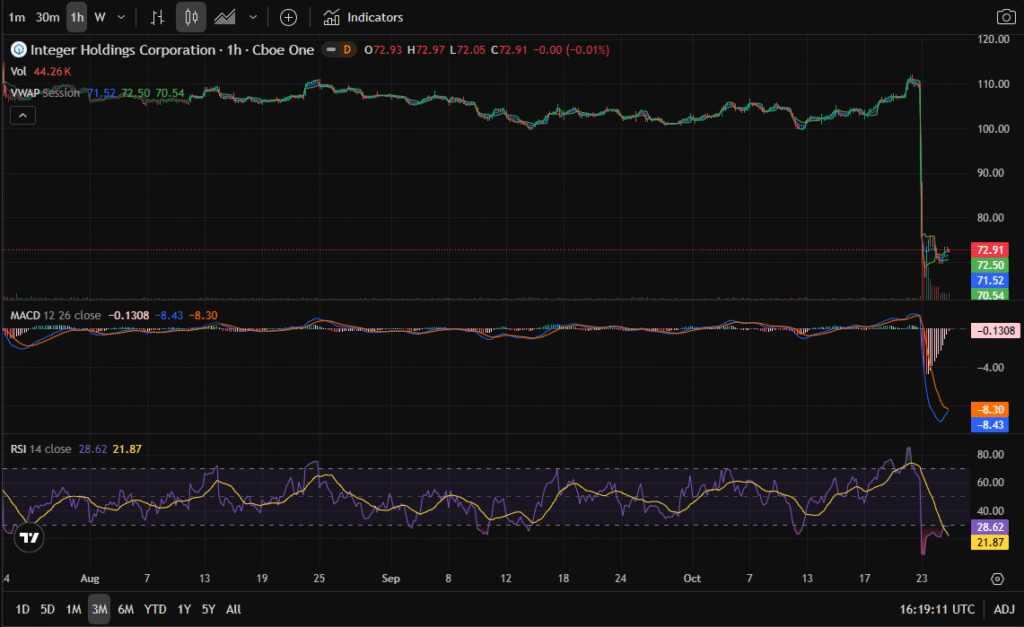
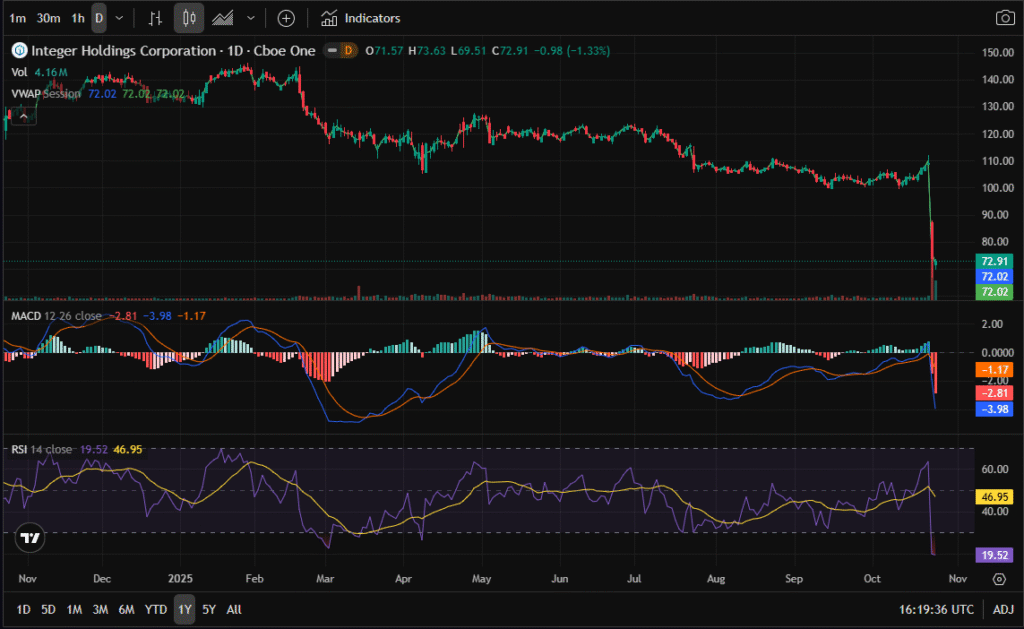
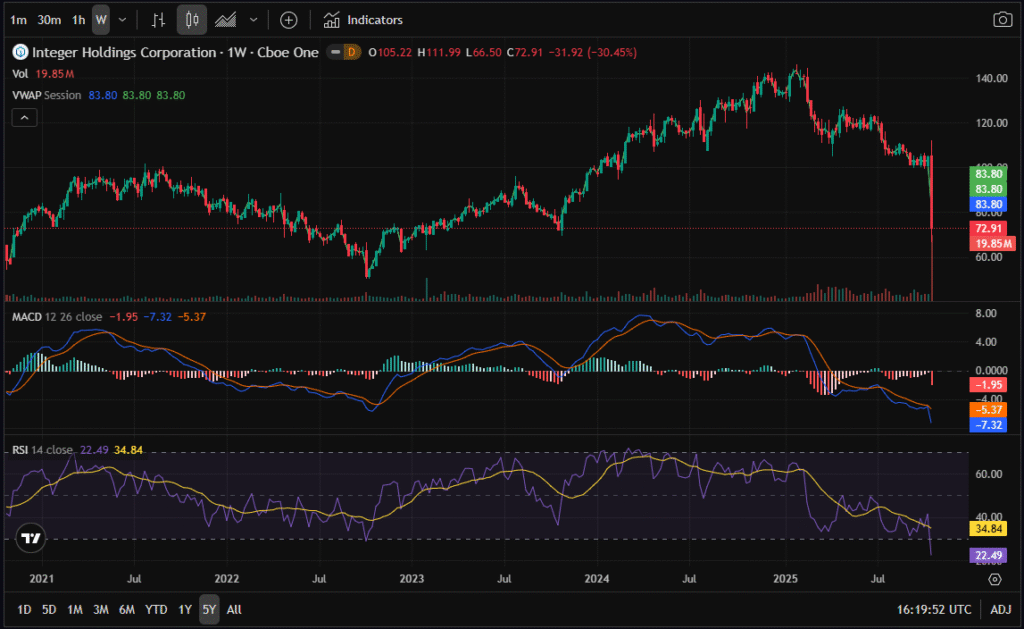
Integer Holdings Corp. (NYSE: ITGR) has just undergone one of the sharpest valuation resets in its recent history, dropping over 30% in a single session following a disappointing 2026 guidance update.
On the 3-month chart, we see a steep vertical drop from the $110 level down to the low $70s, accompanied by a bearish MACD crossover and an RSI deep in oversold territory (~22) — signaling an extreme short-term capitulation.
The 1-year chart mirrors this weakness, printing a new 52-week low and confirming a clear breakdown in momentum. MACD lines continue diverging downward, yet RSI remains heavily oversold — a combination that historically precedes a technical bounce or mean reversion within a few weeks.
The 5-year chart provides long-term context: the stock has broken below its multiyear uptrend but is now retesting a major horizontal support zone around $68–70, which also served as a base during 2022. Weekly RSI near 22.5 suggests seller exhaustion and the formation of a bottoming range.
In short, technical exhaustion is setting in, creating an attractive setup for a volatility rebound — exactly the kind of environment we look for when deploying a Vega-driven LEAPS strategy.
2. Financial Overview
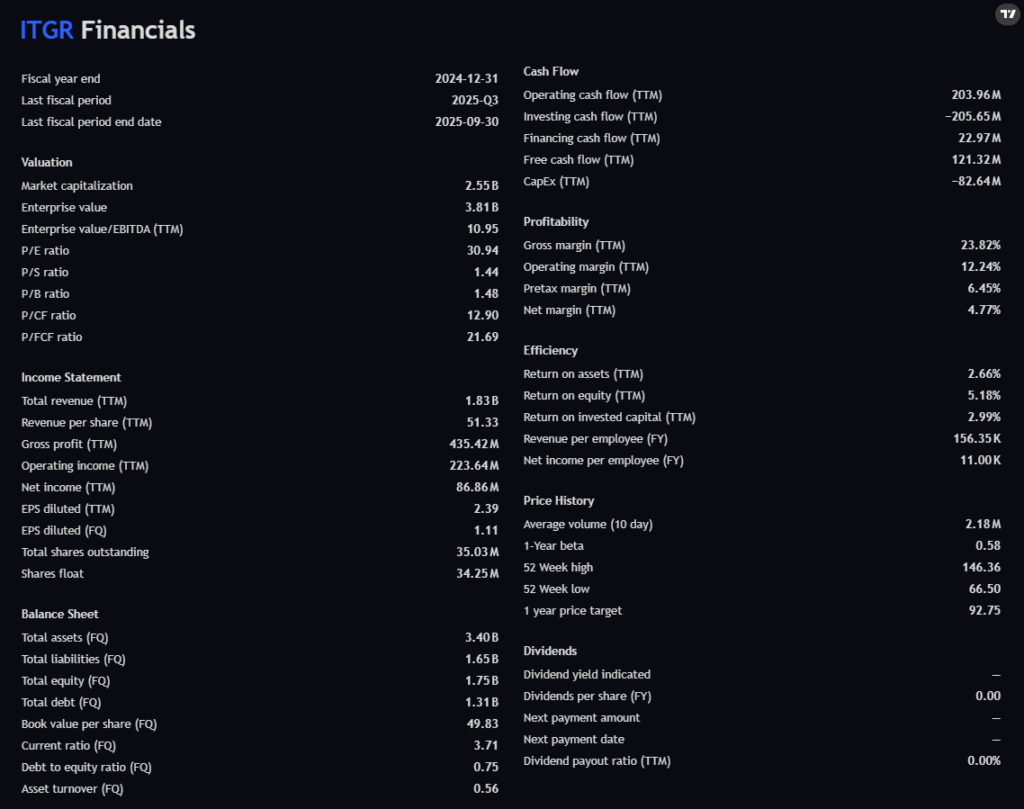
Integer’s fundamentals remain strongly intact despite its valuation reset:
- Total Revenue (TTM): $1.83B
- Net Income (TTM): $86.9M
- Free Cash Flow (TTM): $121.3M (positive, strong margin buffer)
- Gross Margin: 23.8%
- Operating Margin: 12.2%
- Debt/Equity Ratio: 0.75 (healthy leverage)
- Current Ratio: 3.7 (excellent liquidity)
With consistent cash generation, low leverage, and a modest P/B of 1.48, ITGR is financially resilient. Its P/E of 30.9 is elevated due to temporarily muted earnings, but EV/EBITDA of 10.95 remains fair.
In essence, Integer is not a broken company — it’s a temporarily repriced one.
3. News Headlines Recap

Recent headlines confirm the root cause of the drop was forward guidance, not operational weakness:
- “Integer Holdings: Growth Standstill Comes as a Shock” — Seeking Alpha, Oct 24, 2025
- “ITGR Shares Down Despite Q3 Earnings Beat” — Zacks Research, Oct 24, 2025
- “These Analysts Cut Forecasts on Integer Holdings Following Q3 Results” — Benzinga, Oct 24, 2025
- “Integer: Buy ITGR Stock at $75?” — Forbes, Oct 24, 2025
Despite strong Q3 results, management reduced its 2026 sales outlook to flat growth, triggering institutional repricing. A leadership transition to new CEO Payman Khales adds short-term uncertainty but long-term potential for renewed execution discipline.
4. Analyst Price Targets
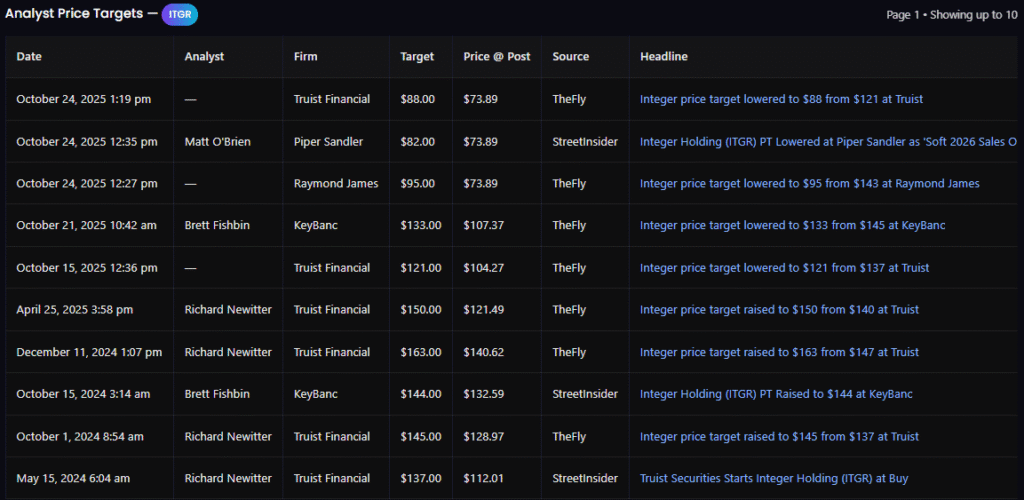
| Date | Firm | New Target | Old Target | % Change |
|---|---|---|---|---|
| Oct 24, 2025 | Truist | $88 | $121 | –27% |
| Oct 24, 2025 | Piper Sandler | $82 | — | n/a |
| Oct 24, 2025 | Raymond James | $95 | $143 | –34% |
Average post-downgrade target = $88, implying ~20% upside from current $72.9 levels.
These synchronized target cuts confirm the valuation reset is now fully priced in — a potential bottoming signal before sentiment recovers.
5. Insider Trading Activity
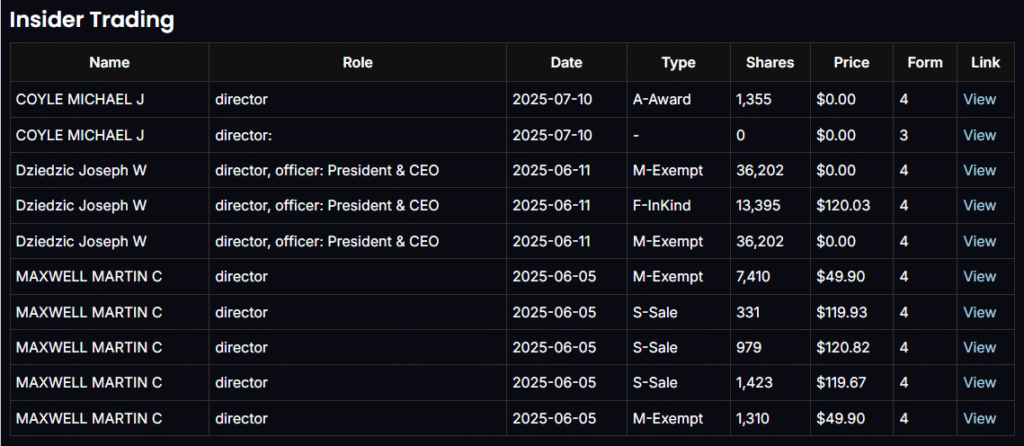
Recent insider activity (June–July 2025) shows no bearish signals:
- Former CEO Joseph Dziedzic exercised options at ~$120 (administrative, not discretionary selling).
- Directors Michael Coyle and Martin Maxwell executed small routine transactions.
- Importantly, there have been no open-market sales since the October selloff — suggesting insiders are holding through the decline.
This neutral-to-bullish insider stance supports a confidence-in-stability interpretation, not insider pessimism.
6. Options Flow Analysis
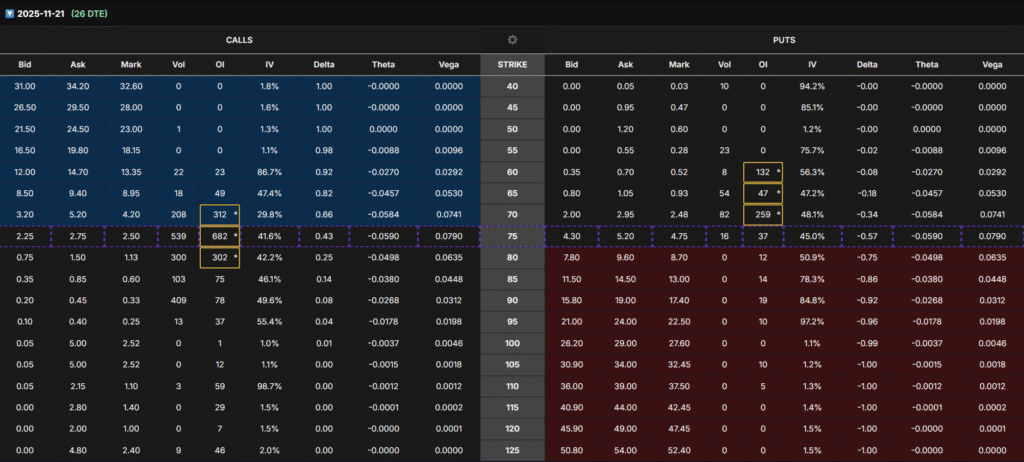
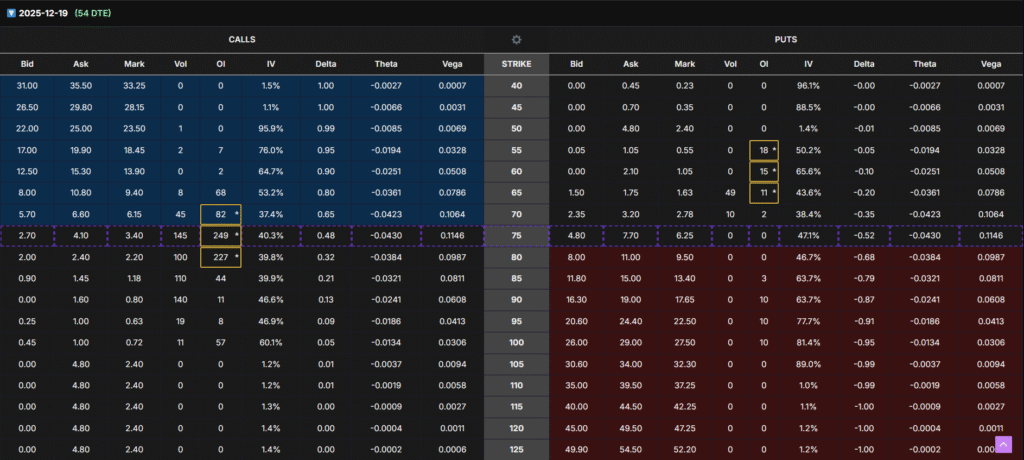
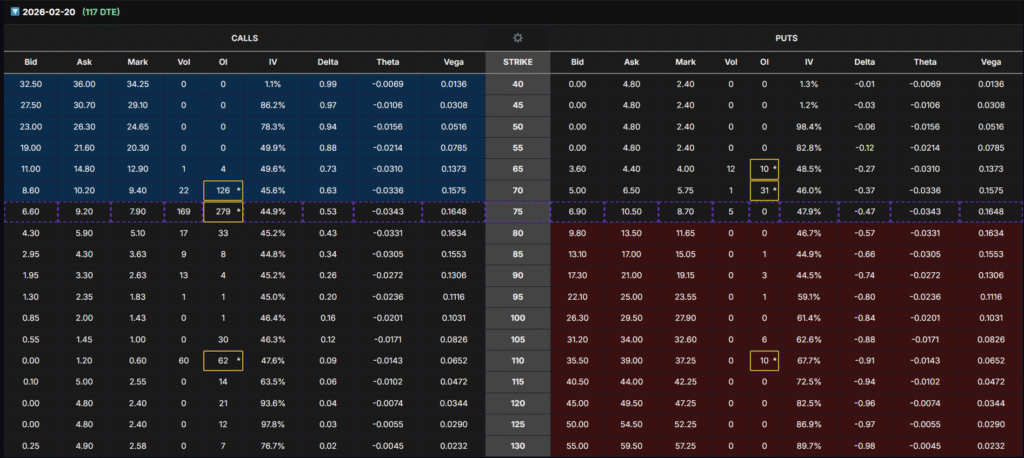
Across all expirations (Nov 2025 → Feb 2026 → May 2026), the $75 strike call repeatedly shows the highest OI concentration, forming what’s called a “strike magnet.”
- Nov (26 DTE): 682 OI at 75C — short-term recovery bets.
- Dec (54 DTE): 249 OI at 75C, 227 OI at 80C — continuation flow.
- Feb (117 DTE): 279 OI at 75C — medium-term accumulation.
- May (201 DTE): 160 OI at 80C — long-term institutional positioning.
This consistent buildup across expirations signals a bullish options flow bias and confirms that the 70–80 strike zone is a favored accumulation range for professionals betting on volatility rebound and price normalization.
7. LEAPS Options Setup (Vega + Delta Play)
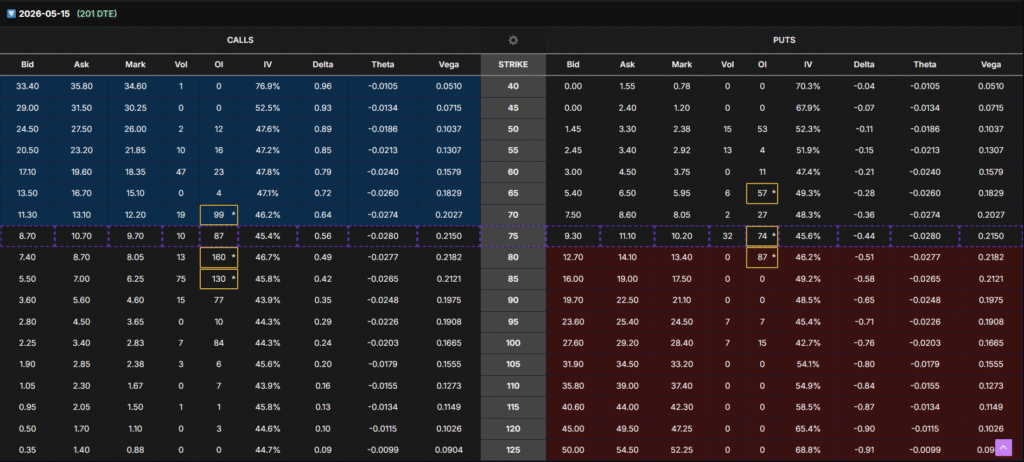
Expiration: May 15, 2026 (≈200 DTE)
Selected Strike: $80 Call
Last Price: $8.05
Delta: 0.49 Vega: 0.218 IV: 46.7% OI: 160
We are deploying a Vega/Delta hybrid strategy — the goal is not to wait for the stock to exceed $80, but rather to profit from the rise in implied volatility (Vega) and directional recovery (Delta) before earnings.
Exit Strategy:
- Close 2/3 of the position at +80% profit before earnings (to secure gains).
- Leave 1/3 of the position running for a potential 100–110%+ outcome.
- Do not hold through earnings; Vega collapses after the event.
8. Entry & Batch Plan
We will be entering this position in three stages to optimize cost and reduce volatility risk:
- First Batch: Enter now while Vega and Delta are both compressed.
- Second Batch: Enter in 1–2 weeks if the options price drops by –40–50% of its value (important: this refers to the options price, not the stock price).
- Third Batch: Enter 1–2 weeks later if the second batch’s option price also drops by –40–50% from its cost basis.
We will hold this LEAPS position for a maximum of 2 months. If the trade hasn’t appreciated meaningfully within that window, we will roll over to the next available long-term expiration.
9. Summary & Trade Thesis
- Technical: Oversold RSI, MACD crossovers near reversal.
- Fundamental: Cash-flow positive, low debt, recession-resilient med-tech sector.
- Sentiment: Downgrades done, insiders holding, analysts see recovery.
- Options Flow: Repeated call accumulation at 75–80 strikes.
- Strategy: Exploit low Vega and Delta by entering before volatility ramps into the next earnings cycle.
This is a high-probability volatility reversion setup — not a speculative momentum play.
⚠️ Disclaimer
This content is for educational and informational purposes only and should not be construed as financial advice or investment recommendations.
Options trading involves substantial risk, including potential loss of the entire premium. Readers are advised to consult a qualified financial professional before making any trading decisions.
Allocate no more than 2% of your total portfolio to this position to preserve risk capital.
Trade responsibly, follow the batch plan, and always protect capital first — profits come to those who manage risk consistently.