🔎 Technical Overview
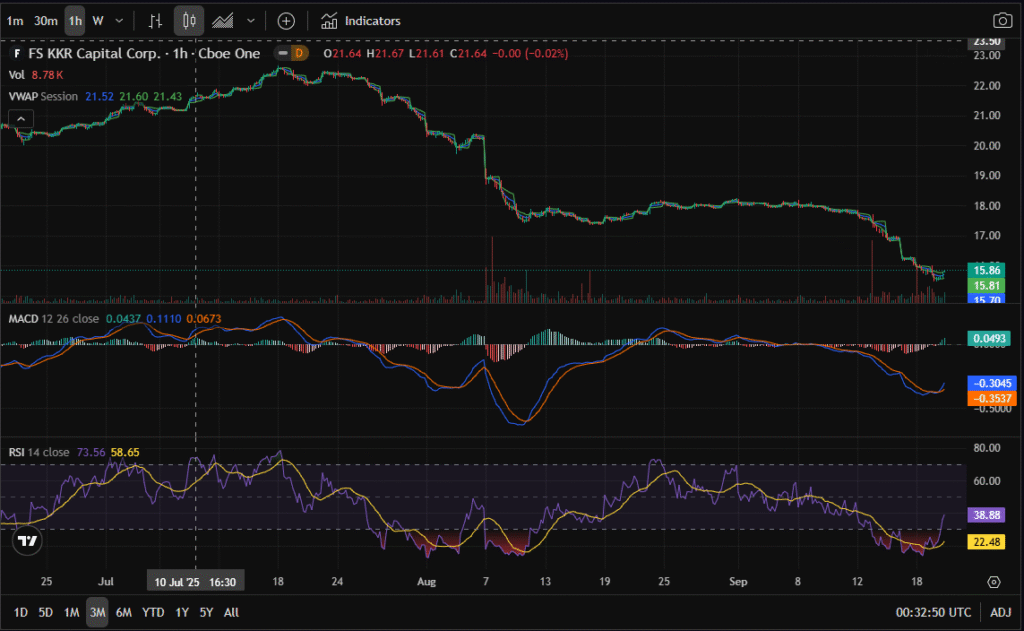
Looking at the 3-month chart, FSK is trading at a recent 3-month low. The MACD has made a bullish crossover, suggesting short-term momentum is shifting away from sellers. RSI recently dipped into oversold levels and is now curling upward, pointing to the possibility of a short-term bounce.
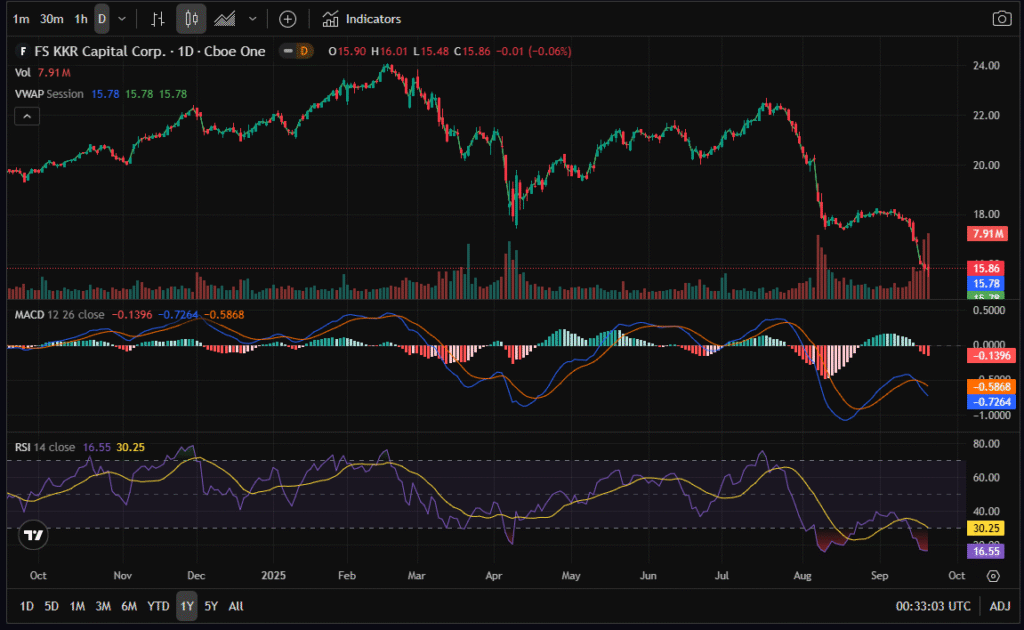
The 1-year chart shows FSK at a 1-year low, with a bearish MACD crossover still in effect and RSI deeply oversold (~16). This indicates the stock is stretched to the downside, but in a confirmed bearish medium-term trend.
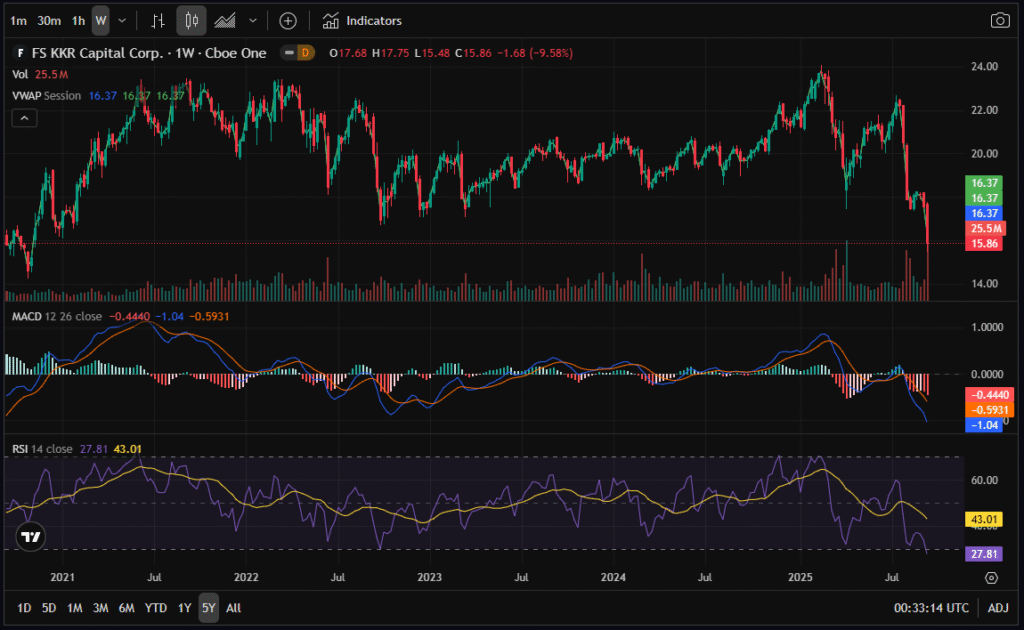
On the 5-year chart, FSK is trading close to its 5-year lows. RSI again shows oversold conditions, while MACD is bearish. Historically, RSI levels this low have preceded rebounds, but the long-term picture remains fragile.
📑 Financial Overview
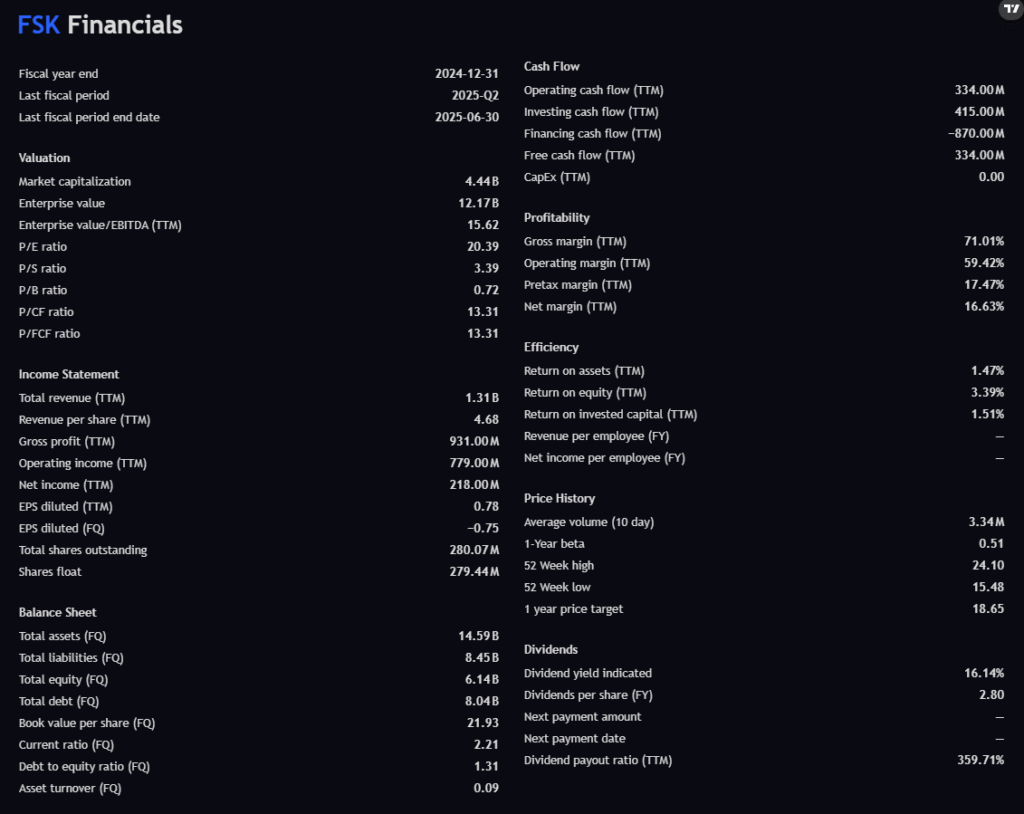
Fundamentals are mixed:
- Positive Free Cash Flow: $334M TTM, which is a strength.
- Strong Gross Margin: 71% with a healthy Net Margin of 16.6%.
- Leverage: Debt-to-equity ratio is high at 1.31, which is typical for BDCs but still a risk.
- Dividend Yield: A massive 16.14%, but the payout ratio (359%) suggests this is not sustainable long-term.
- Valuation: Trades below book value (P/B 0.72), making the stock look undervalued on an asset basis.
🏦 Analyst Price Targets
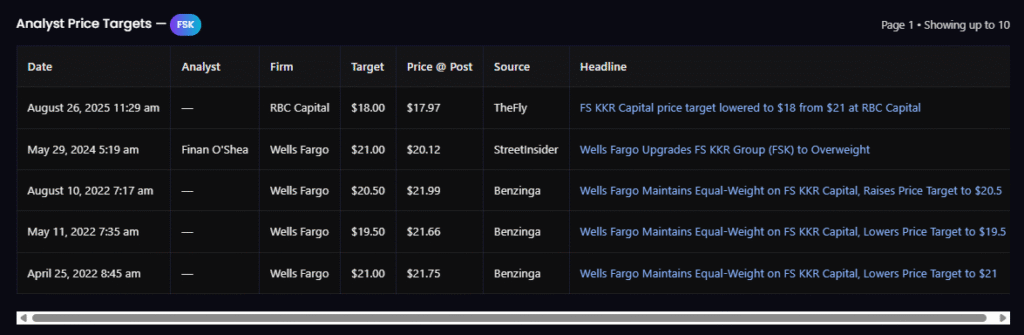
- RBC Capital (Aug 2025): Target $18.00 (cut from $21).
- Wells Fargo (May 2024): Target $21.00, upgraded to Overweight.
- Historical targets have trended downward from $21–20.5 → $18 today.
This indicates modest upside (about 13–15% from current levels), but analysts are cautious on growth prospects.
🕵️ Insider & Political Trades
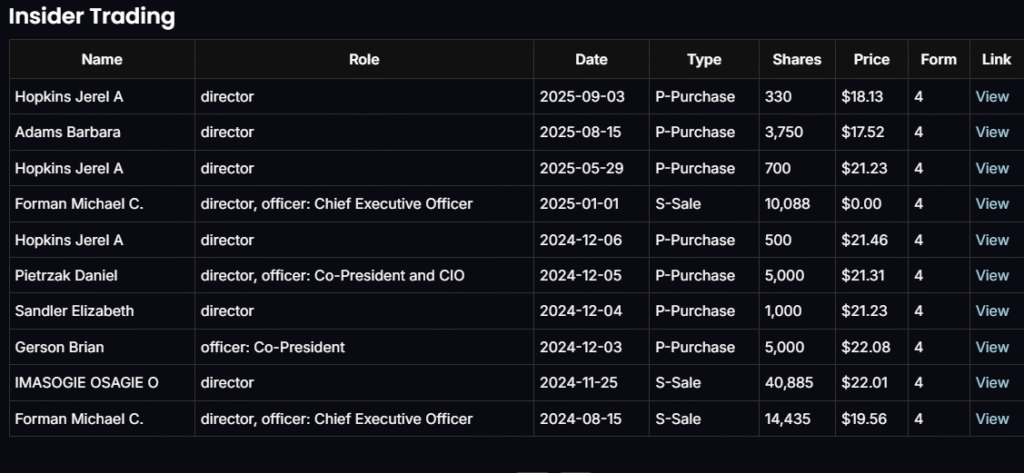

- Recent insider purchases: Multiple directors (Hopkins, Adams, Pietrzak, Sandler, Gerson) bought shares between $17–22 in 2024–2025.
- Recent sales: CEO Michael Forman sold at $19–22 in 2024.
- Bullish Tilt: Small insider buys near current levels (~$17–18) suggest confidence, though the amounts are not huge.
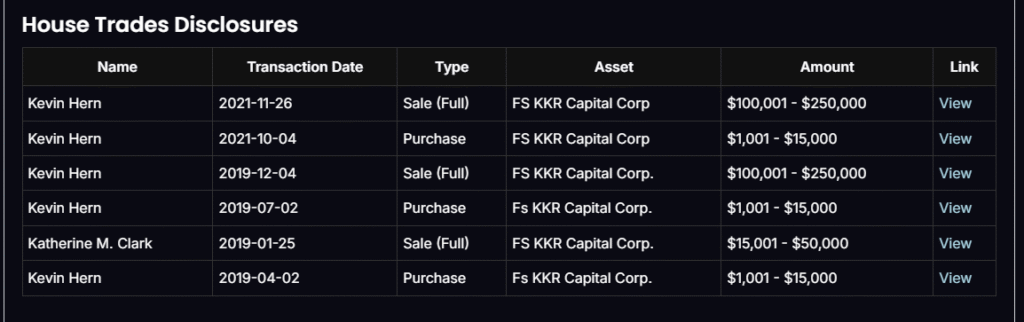
Senate/House trades are older (2019–2021) and less relevant to today’s picture.
📈 Options Chain & LEAPS Strategy
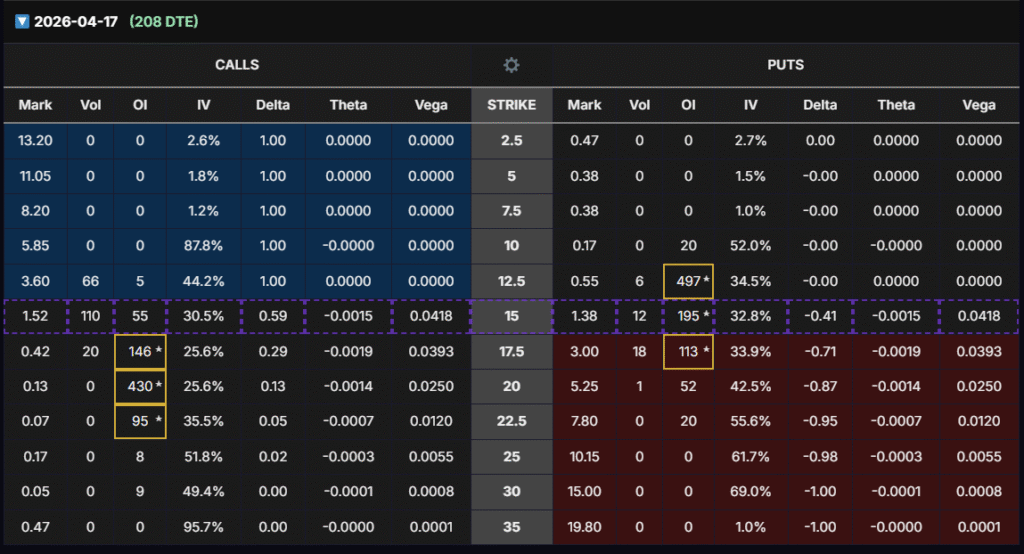
- Chosen Contract: $15 Strike Call (Apr 17, 2026, 208 DTE).
- Delta: 0.59 → efficient directional exposure (option moves ~59% of stock’s move).
- Vega: 0.0418 → strong exposure to IV increases, which tend to spike into earnings.
- Open Interest: 195 (plus 110 new contracts traded today, likely rolling into OI).
- IV: ~30.5% → relatively cheap for a beaten-down stock.
🎯 Trade Thesis
We are targeting the $15 strike Apr 2026 Call because:
- It is at-the-money, giving the strongest mix of delta and vega.
- It has the highest liquidity near the money.
- Implied volatility is cheap to buy, setting us up to profit when IV expands before earnings.
This trade is not dependent on the stock breaking out significantly. Even a modest 10% stock rise can produce 30–40%+ gains in the option due to delta + vega amplification. A 20% rally combined with IV expansion could result in 2–3x returns.
📌 3-Batch Entry Strategy (Risk Management)
We will enter this trade in three batches to control risk and reduce timing pressure:
- Batch 1 (Now): Enter initial position at ~$1.52 option price.
- Batch 2 (1–2 weeks later): Enter again only if the option price drops –40% to –50%. (⚠️ Important: this refers specifically to the options price, not the stock price).
- Batch 3 (1–2 weeks after Batch 2): Enter final tranche if the Batch 2 options price also drops –40% to –50%.
By layering entries this way, we reduce cost basis and maximize payoff when volatility expands ahead of earnings.
⚠️ Disclaimer & Allocation Guidance
- This analysis is for educational purposes only and should not be considered financial advice.
- Allocate no more than 2% of your total portfolio to this strategy.
- Options involve substantial risk and may not be suitable for all investors.
- Always do your own research and consult a licensed financial advisor before making investment decisions.
✅ Bottom Line:
FSK is deeply oversold and trading near multi-year lows. The $15 Apr 2026 calls provide an attractive opportunity to benefit from both a modest price recovery and implied volatility expansion. By entering in three controlled batches and keeping allocation small, we set up a favorable risk/reward play in an otherwise high-risk, high-yield stock.